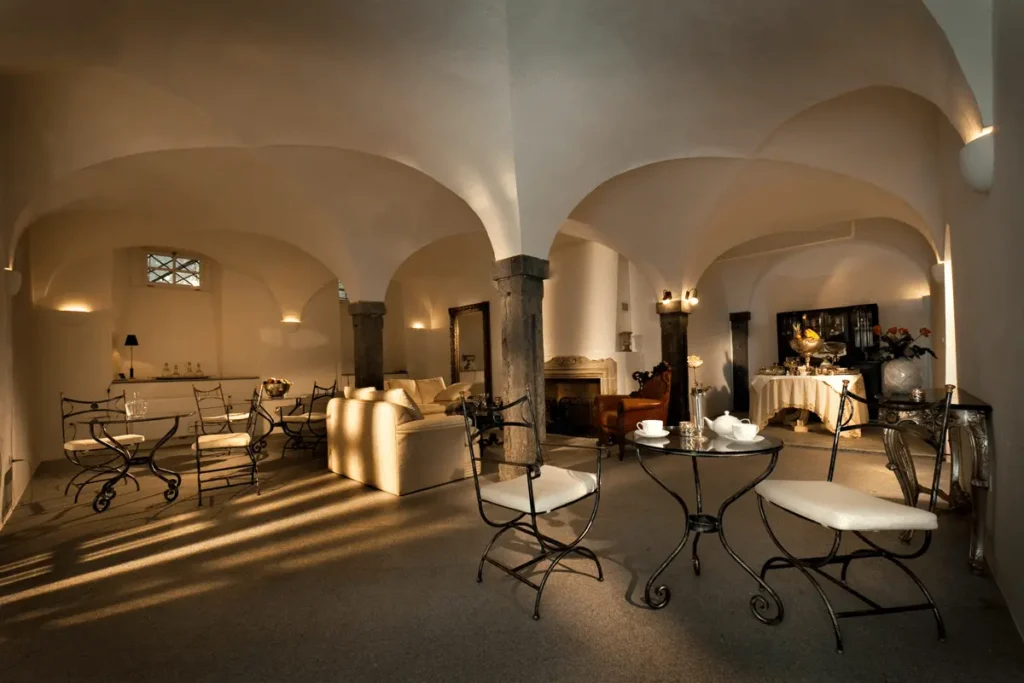
Antiq Palace Ljubljana occupies a protected 16th-century palatial residence on Gosposka ulica—”Gentry Street“—where Venetian-descended Barons of the Lazarini family maintained their urban seat for over four centuries.
Built atop 2,000-year-old foundations from Roman Emona, the palace retains original frescoes, monumental stone staircases, and vaulted ceilings across 18 individually designed suites. The property’s lineage as the residence of city mayors, judges, and vicars establishes its role as a historic seat of civic authority within Ljubljana’s medieval core.
For travellers seeking residences where architectural legacy defines the experience, explore the best historic hotels in Ljubljana.
Antiq Palace Ljubljana ★★★
The Antiq Palace commands one of Ljubljana’s most historically significant addresses. Located at Gosposka ulica 10 within the Novi trg district, this protected cultural monument was constructed in the 16th century as the primary residence of the Lazarini family—Venetian merchants who secured the title of Barons in the 1600s. The palace’s position adjacent to medieval city walls and Roman necropolis sites reinforces its role as a landmark of continuous urban authority spanning two millennia.
Antiq Palace Ljubljana is a prestigious member of Historic Hotels of Europe housed in a 16th-century noble residence, offering 18 luxury suites where original frescoes and Roman foundations meet a quiet, aristocratic atmosphere.
The building rests on Roman foundations from ancient Emona, with archaeological remnants preserved within the structure’s deep levels. This vertical continuity—from 1st-century Roman stone to Renaissance masonry—creates a physical archive of Ljubljana’s transformation from imperial outpost to Baroque capital. The palace served successive generations of city mayors, judges, and high-ranking vicars, maintaining its status as a residence where civic decisions were exercised.
The property’s restoration prioritized architectural authenticity. Traditional natural materials—stone, wood, and lime paints—were specified to preserve original frescoes and structural artifacts. Several suites retain rare 16th-century wall frescoes and decorative masonry uncovered during conversion, offering direct visual contact with the palazzo’s original ornamental program. The monumental stone staircases and vaulted ceilings remain structurally unaltered, preserving the spatial hierarchy typical of Slovenian noble architecture during the high Renaissance.
The 18 suites range from 45 to over 100 square meters, with period-modeled furnishings scaled to the palazzo’s grand proportions. Each suite includes fully equipped kitchenettes or full kitchens, individual climate control, and fiber-optic WiFi infrastructure designed for extended residential stays.
The property’s layout incorporates three distinct lounge areas, a library, and specialized boardroom suites—spaces that translate the palace’s historic function as a site of high-privacy counsel into contemporary executive utility.
Two secluded internal stone courtyards and private gardens provide controlled micro-climates insulated from street-level urban activity. These enclosed green spaces mirror the palazzo’s original design as a self-contained noble compound within the medieval city grid. The lower historic levels now house a luxury spa with saunas, whirlpool, and massage treatment rooms—wellness infrastructure integrated into the building’s ancient structural foundation.
On-site amenities include 24-hour professional concierge services and private parking, a logistical advantage rare within Ljubljana’s pedestrianized old town center. The property’s interior design received recognition from Hubertus von Hohenlohe in “500 Very Special Hotels of the World,” validating its position among Europe’s architecturally distinguished accommodations.
The Antiq Palace offers residency within a continuously inhabited seat of authority—a 16th-century baronial compound where Roman stone, Renaissance frescoes, and modern residential infrastructure occupy the same vertical structure.
Check Availability & Rates →Four centuries of civic authority compressed into eighteen frescoed suites—where Roman foundations anchor Renaissance grandeur, and stone courtyards hold the silence that privilege has always required.
FAQ: Antiq Palace Ljubljana
What is the historical significance of Antiq Palace Ljubljana?
Antiq Palace Ljubljana is a protected 16th-century cultural monument built as the residential seat of the noble Lazarini family, Venetian-descended Barons who held civic prominence for over 400 years. The palace rests on Roman foundations from ancient Emona and served as the home of city mayors, judges, and high-ranking vicars, establishing it as a continuous seat of urban authority since Roman imperial administration.
What original architectural features are preserved at Antiq Palace?
The property retains original 16th-century wall frescoes, decorative masonry, monumental stone staircases, and vaulted ceilings. Restoration used traditional materials—stone, wood, and lime paints—to preserve structural artifacts and period ornamental programs. Several suites display rare uncovered frescoes that provide direct visual contact with the palazzo’s Renaissance design.
What amenities does Antiq Palace Ljubljana offer?
The palace provides 18 boutique suites (up to 100+ sqm) with fully equipped kitchens, fiber-optic WiFi, and individual climate control. On-site facilities include a luxury spa with saunas and whirlpool, three lounge areas, a library, boardroom suites, 24-hour concierge, and private parking—a rare amenity in Ljubljana’s historic pedestrian zone.
Where is Antiq Palace located in Ljubljana?
Antiq Palace is located at Gosposka ulica 10 (“Gentry Street”) in the historic Novi trg district, directly adjacent to medieval city walls and Roman necropolis sites. The address has maintained its prestige as one of Ljubljana’s premier urban landmarks for four centuries, positioned within the city’s original medieval grid.
Experience Ljubljana’s Noble Legacy
The Antiq Palace demonstrates how Roman infrastructure, Renaissance authority, and modern residential precision occupy a single protected structure.
For travelers seeking accommodations where architectural lineage defines the experience, Ljubljana’s portfolio includes the commanding Belle Époque grandeur of Grand Hotel Union Eurostars and the meticulously restored merchant residence of Hotel Heritage Ljubljana, each offering distinct interpretations of the city’s layered urban authority.
For more curated itineraries and luxury-focused travel insights, visit Your Luxury Guide. For official travel information and destination updates, visit Slovenia tourism-info.
Your Luxury Guide — Where Exceptional Travel Begins.