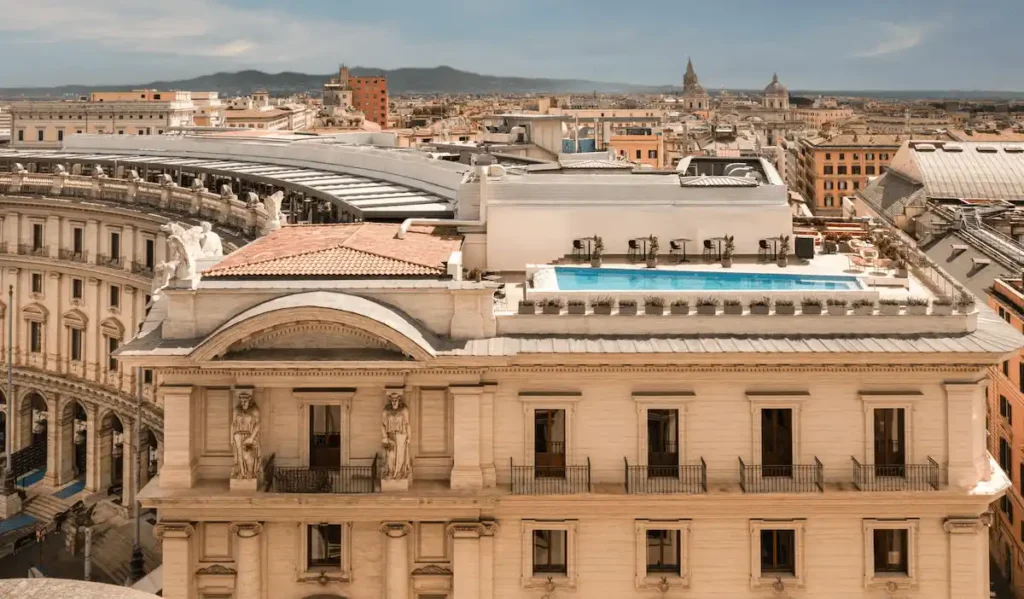
Anantara Palazzo Naiadi Rome Hotel occupies Piazza della Repubblica, where the semicircular colonnade mirrors the original perimeter of the Baths of Diocletian—the largest imperial thermae complex ever constructed in Rome. Built between AD 298-306, these baths accommodated 3,000 bathers simultaneously and represented the apex of Roman engineering and social hierarchy.
The hotel’s façade follows the exact curve of the ancient caldarium, positioning guests within the architectural footprint of a structure that once defined imperial authority. This is not proximity to history; this is occupation of a command center where Rome’s most powerful citizens exercised both physical and political dominance.
Anantara Palazzo Naiadi Rome Hotel ★★★★★
The Anantara Palazzo Naiadi stands where Diocletian’s architects chose to demonstrate Rome’s unrivaled supremacy. The Baths of Diocletian were not merely recreational facilities—they were the Empire’s largest statement of hydraulic mastery, covering 130,000 square meters and requiring the construction of a dedicated aqueduct to supply 80,000 cubic meters of water daily.
Anantara Palazzo Naiadi is a crescent-shaped neoclassical marvel built atop the ruins of the Diocletian Baths, offering Rome’s most iconic rooftop vantage point over the historic Piazza della Repubblica.
The hotel’s 238 rooms and suites occupy a 19th-century palazzo built directly upon these ancient foundations, with the archaeological layer visible beneath climate-controlled glass in the lobby. Guests descend through Roman history: the modern spa complex sits at the same depth as the original hypocaust system that heated the imperial baths, creating a vertical timeline of 1,700 years.
The semicircular structure is no architectural flourish—it traces the exact exedra of the baths’ natatio, the massive swimming pool where senators and military commanders held informal councils while the Empire’s business was conducted in temperature-controlled water.
Michelangelo later transformed the frigidarium into the Basilica of Santa Maria degli Angeli, visible directly across the piazza, making this location the only place in Rome where you can occupy both the secular and sacred transformations of imperial space simultaneously.
The hotel’s rooftop terrace provides unobstructed views of this architectural palimpsest: Renaissance church, Baroque fountains, ancient brick walls, and modern luxury compressed into a single sightline.
Inside, the Anantara spa descends two levels below street grade, placing treatments at the precise elevation where Roman citizens once moved through hot rooms, cold plunges, and massage chambers. The heated indoor pool reflects this heritage—its 28°C/82°F temperature matches historical accounts of the tepidarium’s maintained warmth.
The onsite restaurant sources within the Lazio region, but this is not farm-to-table idealism; it’s the restoration of supply chains that once fed the bath complex’s massive daily operations. Diocletian’s baths required a permanent staff of thousands; the hotel’s 200+ employees maintain that tradition of operational scale.
The rooms facing Piazza della Repubblica look directly onto the Fountain of the Naiads, commissioned in 1901 to mark the unification of Italy—a modern nation built literally atop the ruins of an ancient one. Suites on the courtyard side overlook the preserved brick walls of the caldarium, where thermal gradients of 49°C/120°F+ once demonstrated Rome’s conquest of nature itself.
This is spatial dominance: every window frames a documented moment when power was visibly exercised. The Eternal City built itself in layers, and this hotel occupies the center of that vertical accumulation.
Check Availability & Rates →To stay at Anantara Palazzo Naiadi is to occupy the thermal heart of Diocletian’s empire—where water, heat, and authority converged in the largest engineering triumph of the ancient world, now preserved beneath your feet.
FAQ: Anantara Palazzo Naiadi Rome Hotel
What makes Anantara Palazzo Naiadi Rome Hotel historically significant?
The hotel stands on Piazza della Repubblica, directly overlooking the Baths of Diocletian—the largest thermal complex in ancient Rome, built AD 298-306. The hotel’s curved façade follows the original perimeter of the caldarium (hot baths), and archaeological remains are visible beneath the lobby floor. This location represents the Empire’s peak hydraulic engineering and social command.
How does the hotel incorporate the Baths of Diocletian into the guest experience?
The Anantara spa occupies the same elevation as the original Roman hypocaust heating system, two levels below street grade. The indoor pool temperature (28°C/82°F) mirrors the ancient tepidarium’s documented warmth. Guests can view preserved brick walls of the caldarium from courtyard-facing suites and walk the exact curve of the natatio (swimming pool) that served 3,000 bathers daily.
What amenities does Anantara Palazzo Naiadi Rome Hotel offer?
The hotel provides 238 rooms and suites, a two-level spa with heated indoor pool, rooftop terrace with views of Michelangelo’s Basilica of Santa Maria degli Angeli (built within the bath ruins), fitness center, and an onsite restaurant sourcing from Lazio region. Archaeological displays in the lobby showcase the building’s Roman foundations.
Why is the hotel’s location at Piazza della Repubblica architecturally important?
The semicircular colonnade of Piazza della Repubblica traces the outline of Diocletian’s massive natatio (outdoor pool). This is the only location in Rome where the urban plan directly preserves an ancient thermal complex’s footprint at full scale. The Fountain of the Naiads (1901) marks Italy’s unification atop imperial ruins—making the site a vertical timeline of power transitions.
Imperial Authority, Thermal Precision
Anantara Palazzo Naiadi delivers occupation of Rome’s largest demonstration of hydraulic mastery—where Diocletian’s engineers moved 80,000 cubic meters of water daily to serve an empire. The hotel’s position on the ancient exedra places modern travelers within the social hierarchy of the baths, where proximity to heated water signaled political access. This is verified spatial dominance preserved across seventeen centuries.
Explore the intersection of Renaissance transformation and baroque grandeur at Six Senses Rome or discover neoclassical command at Hotel de Russie Rome.
For more curated itineraries and luxury-focused travel insights, visit Your Luxury Guide. For official travel information and destination updates, visit Italy tourism-info.
Your Luxury Guide — Where Exceptional Travel Begins.