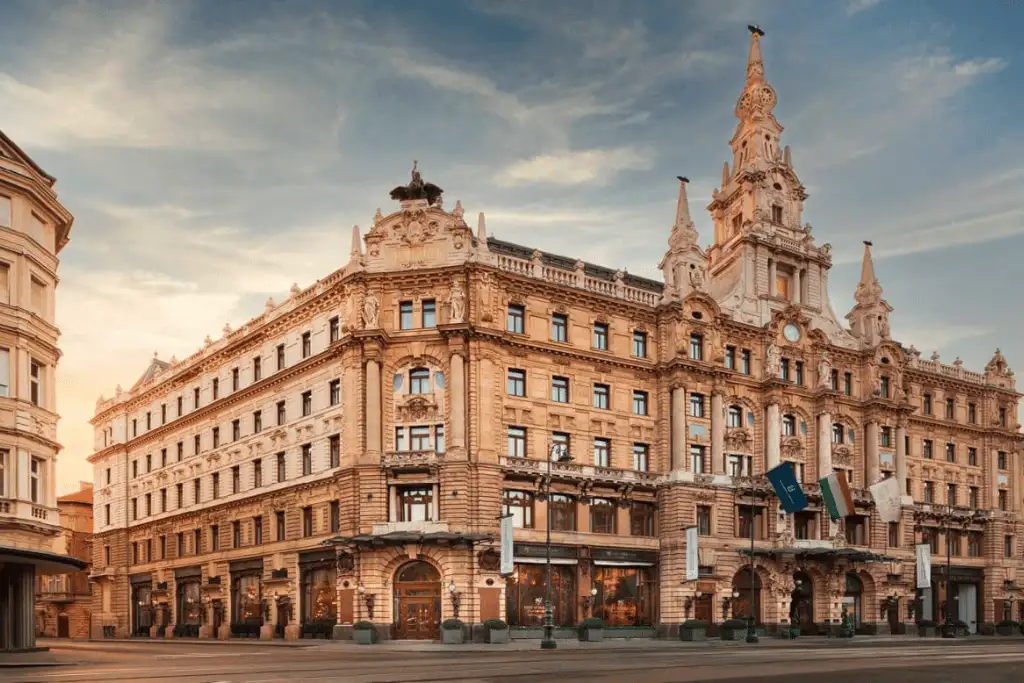
Anantara New York Palace Budapest commands the intersection where 19th-century American ambition meets Hungarian imperial architecture. Designed by Alajos Hauszmann—architect of the Royal Palace and Parliament—this 1894 insurance headquarters was engineered to project permanence across Europe.
The same marble halls that once housed actuarial power became the epicenter of Hungary’s literary revolution, where the Nyugat generation rewrote the nation’s cultural identity. Today’s 185 rooms occupy the restored palace where financial dominance and artistic authority converged.
Anantara New York Palace Budapest ★★★★★
When New York Life Insurance commissioned Alajos Hauszmann in 1894, they demanded a structure that would dwarf Budapest’s banking district. Hauszmann—fresh from expanding the Royal Palace—delivered a seven-story eclecticism masterpiece that merged Italian Renaissance facades with Viennese imperial scale. The building’s corner turrets weren’t decorative flourishes; they were territorial markers announcing American capital’s arrival on the Grand Boulevard.
Anantara New York Palace Budapest is an architectural marvel of the Belle Époque, famously housing the “New York Café”—widely regarded as the most beautiful café in the world—within its opulent gilded interiors.
The ground floor’s New York Café operated as strategic theater. While insurance clerks calculated risk three floors above, Budapest’s literary elite—the Nyugat generation—commandeered the gilded hall as their operational headquarters. Ferenc Molnár drafted plays beneath Venetian chandeliers. Endre Ady composed revolutionary poetry surrounded by 19th-century frescoes. The café became what the insurance company’s boardroom never achieved: a seat of cultural authority that redefined Hungarian modernism.
The building survived two world wars and four decades as a socialist-era warehouse before the 2006 restoration reclaimed Hauszmann’s original vision. Today’s 185 guest rooms occupy what were once administrative floors, their 14-foot ceilings and silk-wallpapered interiors translating insurance empire scale into residential luxury. Italian marble bathrooms reference the building’s Mediterranean design language, while turret suites offer 360-degree city views from spaces originally designed for executive oversight.
The Grand Staircase maintains its function as a threshold between worlds. Gold-leaf balustrades guide guests from the Grand Boulevard’s commercial energy into the palazzo’s imperial quiet—the same transition 1890s insurance executives experienced ascending to their offices. Each marble step was quarried specifically for this project, Hauszmann’s specifications demanding stone that could withstand both physical traffic and symbolic weight.
The Anantara Spa occupies former administrative wings, its heated indoor pool and Hungarian mud treatments installed within rooms where actuaries once assessed Central European risk portfolios. The White Salon Restaurant overlooks the New York Café from what served as the director’s floor, modern Hungarian cuisine now served in spaces designed for corporate command. Even breakfast becomes a performance of inherited authority—guests dine beneath the same frescoed ceiling that witnessed Hungary’s literary transformation.
The Poet Bar, named for the Nyugat generation, operates in a ground-floor salon that once functioned as the building’s public interface. Classic cocktails are mixed where clerks once processed policies, the intimate space maintaining its role as a zone where commercial transaction meets cultural exchange. Anantara’s “Journeys” program—vintage car tours, private Opera House access—extends the building’s historic function as a gateway between Budapest’s diplomatic and cultural districts.
This isn’t a hotel that merely occupies a historic building. The property’s value derives from architectural intention: Hauszmann designed permanence, and both the insurance empire and literary revolution that followed proved him correct. The 1894 structure projected American financial dominance; the early 20th-century café generated Hungarian modernism.
Today’s guest experience synthesizes both legacies—inhabiting spaces engineered for authority, now refined for residential luxury. Every gilded detail, every marble threshold represents calculated 19th-century ambition that contemporary restoration has preserved without dilution.
Check Availability & Rates →Where Hauszmann’s imperial architecture housed American financial dominance and birthed Hungarian literary modernism, today’s guest occupies the converging point of both empires—sleeping in rooms designed for corporate command, dining in halls where poets revolutionized a nation’s cultural identity.
FAQ: Anantara New York Palace Budapest
What makes Anantara New York Palace Budapest historically significant?
The building was designed by Alajos Hauszmann, architect of Budapest’s Royal Palace and Parliament, as the 1894 European headquarters for New York Life Insurance. Its ground-floor New York Café became the operational headquarters for Hungary’s Nyugat literary generation, where Ferenc Molnár and Endre Ady created works that defined Hungarian modernism. The structure represents the intersection of American financial empire and Central European cultural revolution.
How many rooms does Anantara New York Palace Budapest have?
The hotel features 185 guest rooms and suites distributed across the restored 1894 palace. Rooms occupy former administrative floors with 14-foot ceilings, silk wallpapers, and Italian marble bathrooms. Signature turret suites are located in the building’s corner towers, offering 360-degree Budapest skyline views from spaces originally designed for executive offices.
What is the New York Café at Anantara Budapest?
The New York Café is a fully restored 19th-century café featuring original Venetian glass chandeliers, gilded stucco, and frescoed ceilings. Operating continuously since 1894, it served as the primary meeting place for Hungary’s Nyugat generation of writers and poets. Today it functions as the hotel’s breakfast venue and remains open to the public, maintaining its historic role as a cultural landmark.
What amenities does Anantara New York Palace Budapest offer?
The hotel provides an Anantara Spa with heated indoor pool and Hungarian mud treatments, the Poet Bar for cocktails, White Salon Restaurant for modern Hungarian cuisine, and “Anantara Journeys” including vintage car tours and private Opera House access. The Grand Staircase and preserved architectural details throughout the building serve as integrated design amenities reflecting the property’s imperial heritage.
A Palace Where Two Empires Converge
Anantara New York Palace Budapest delivers what few properties can verify: documented architectural authority and cultural transformation occurring within the same walls. Hauszmann’s 1894 design projected permanence; the building’s subsequent history—financial headquarters, literary epicenter, restored luxury hotel—proves his ambition justified. This is inherited command, available for occupancy.
For comparable imperial properties, explore Corinthia Budapest and Párisi Udvar Hotel Budapest.
For more curated itineraries and luxury-focused travel insights, visit Your Luxury Guide. For official travel information and destination updates, visit Hungary tourism-info.
Your Luxury Guide — Where Exceptional Travel Begins.