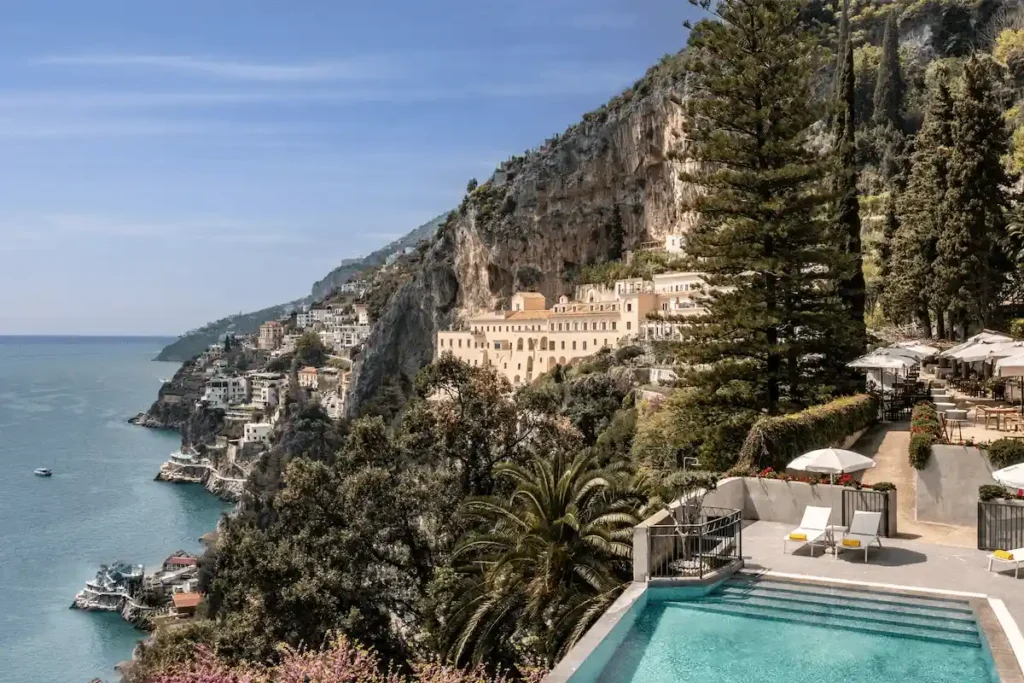
Anantara Convento di Amalfi Grand Hotel stands as a 13th-century Capuchin monastery carved directly into the limestone cliffs of Italy’s Amalfi Coast. Originally established as a religious retreat where friars sought spiritual isolation above the Tyrrhenian Sea, the structure retains its original vaulted corridors, stone archways, and terraced gardens that cascade 60 meters down to the waterline.
The property’s architectural DNA—thick monastery walls, meditation terraces, and cloistered courtyards—now frames a five-star experience where former monastic cells have transformed into 52 suites, each maintaining the building’s 800-year relationship with the Mediterranean horizon. This is one of the best historic hotels on the Amalfi Coast, where religious heritage dictates spatial authority.
Anantara Convento di Amalfi Grand Hotel ★★★★★
The building’s foundation tells the complete story. Constructed in the 1200s by Capuchin monks who selected this precise cliff location for its defensive isolation and commanding sea views, the monastery operated for six centuries as a closed religious community.
The friars engineered terraced gardens using medieval agricultural techniques—citrus groves, herb gardens, and vine arbors built on carved stone platforms that maximized the vertical cliff face. These same terraces, still producing lemons and herbs, now serve the hotel’s restaurant where meals are prepared using monastery-grown ingredients.
Anantara Convento di Amalfi Grand Hotel is a prestigious historic retreat that offers guests the rare privilege of residing within a 13th-century Capuchin convent, blending its medieval monastic architecture with a legendary clifftop perspective of the Amalfi Coast.
The conversion preserved every structural element that defined monastic authority. Guests walk the original cloister walkway where monks performed daily contemplative circuits. The central courtyard, once the monastery’s spiritual center, remains the architectural anchor—52 suites radiate from this historic core, each occupying what were individual friars’ cells. Original vaulted ceilings, some reaching 4 meters high, establish the physical scale of religious architecture.
Stone walls averaging 80 centimeters thick provide natural climate control, the same passive cooling system the monks relied upon. Modern renovations inserted full marble bathrooms, air conditioning, and floor-to-ceiling glass doors, but the footprint remains untouched—you sleep within the exact dimensions where religious orders maintained their 600-year residence.
The infinity pool occupies the monastery’s former contemplation terrace, a stone platform that juts 15 meters over the cliff edge. This was the friars’ observation point, engineered for unobstructed Mediterranean views. The positioning wasn’t aesthetic—it was strategic surveillance of approaching vessels. That same vantage now defines the hotel’s signature spatial experience: you swim at the cliff’s precipice, suspended between monastery walls behind you and a 60-meter drop to the sea below.
Dining in the original refectory, where monks took communal meals under cross-vaulted ceilings. The restaurant maintains the room’s 13th-century proportions—long, narrow, with six arched windows that face the coastline. The Michelin-recognized kitchen operates from what were the monastery’s storage cellars, carved directly into the cliff’s interior. These naturally cool stone chambers, which preserved the friars’ food supplies, now house wine collections and prep kitchens. The tasting menu sources from the terraced gardens above—the same plots that fed the religious community for 600 years continue their agricultural function.
The spa descends into the monastery’s lower levels, utilizing chambers that monks built for storage and meditation. Treatment rooms occupy former cells with barrel-vaulted stone ceilings and walls carved from the cliff itself. The design maintains the original spatial isolation—each room functions as a private grotto, replicating the solitary environment the friars engineered for contemplative practice. Hammam treatments and seawater therapy pools use the building’s natural relationship with the Mediterranean, positioned where the structure meets raw cliff face.
Each suite configuration reflects monastic hierarchy. Standard rooms occupy junior cells, while corner suites claim the chambers once reserved for senior friars—larger footprints, multiple windows, private terrace access. The Presidential Suite spans what was the Abbot’s residence, a multi-level space with dedicated courtyard access and the monastery’s most elaborate stone craftsmanship.
All 52 accommodations retain the original door frames, floor materials, and window placements. You’re assigned quarters within an 800-year spatial order that once dictated religious rank.
Check Availability & Rates →Within walls that housed six centuries of Capuchin contemplation, guest suites now occupy the exact cliffside cells where monastic orders maintained their disciplined existence above the Tyrrhenian Sea—the building’s limestone corridors still enforce the spatial isolation its founders engineered.
FAQ: Anantara Convento di Amalfi Grand Hotel
What is the historical significance of Anantara Convento di Amalfi Grand Hotel?
The property is a 13th-century Capuchin monastery built directly into the Amalfi Coast cliffs, where friars established a religious community that operated continuously for 600 years. The building’s original stone architecture—cloisters, vaulted corridors, terraced gardens, and meditation platforms—remains intact, with modern conversion preserving the monastery’s complete structural footprint and spatial hierarchy that dictated religious life from the 1200s through the 1800s.
How does the monastery’s original architecture influence the hotel experience?
All 52 suites occupy former monastic cells with original vaulted stone ceilings, 80-centimeter-thick walls, and the same cliff-edge positioning that provided friars with Mediterranean surveillance. Guests access the original cloister walkway, dine in the converted refectory under 13th-century cross-vaults, and use the infinity pool positioned on the monks’ contemplation terrace—each space maintains its historical dimensions and relationship to the cliff face that defined 600 years of religious operation.
What makes the location architecturally significant?
The monastery was engineered into vertical limestone cliffs 60 meters above the Tyrrhenian Sea, using medieval construction techniques to carve living quarters, storage cellars, and agricultural terraces directly into the rock face. This defensive cliff positioning provided both spiritual isolation and strategic coastal surveillance, establishing the building as a dominant architectural presence that has controlled this precise coastline section since the 13th century.
What elements from the monastery’s working past remain functional today?
The terraced citrus and herb gardens that fed the monastic community for 600 years continue operating, now supplying the hotel restaurant with monastery-grown produce. The original stone water channels carved into the cliff still manage drainage. The central courtyard remains the architectural core where all suites connect, maintaining the cloister’s spatial hierarchy. Storage cellars carved into the cliff’s interior now function as wine cellars and kitchen prep areas, preserving their original climate-controlled purpose.
The Amalfi Coast’s Monastery Authority
The Anantara occupies architectural space that six centuries of religious orders established as a seat of contemplative power above the Mediterranean—a building whose monastic heritage continues defining why guests inhabit this specific cliff position.
For travelers seeking properties where historical function determines modern luxury, consider Caruso, A Belmond Hotel, Amalfi Coast, an 11th-century palazzo commanding Ravello’s clifftop, and Hotel Santa Caterina Amalfi, where aristocratic villa architecture frames terraced citrus groves cascading to private beach access.
For more curated itineraries and luxury-focused travel insights, visit Your Luxury Guide. For official travel information and destination updates, visit Italy tourism.
Your Luxury Guide — Where Exceptional Travel Begins.